
Get to Know the Carpenter Bee
The carpenter bee:
a pollinator with a purpose
You hear the buzzing first.
Then you see it: a large, striking bee hovering around your porch, deck, fence or garden. Maybe you've never noticed one quite like it before. Its dark, shiny body and unmistakable buzz make it hard to miss.
Meet the carpenter bee—one of nature's fascinating and often misunderstood pollinators.
To learn more about these unique bees, we sat down with Konrad Bouffard, expert beekeeper with Round Rock Honey, to talk about what makes carpenter bees different, the important role they play in our ecosystem, and how we can make room for them while still protecting the places we call home.
So what exactly is a carpenter bee? Do they sting? Why do they drill into wood? And how can we coexist with them?
As it turns out, there's much more to these big, buzzing bees than meets the eye.
Then you see it: a large, striking bee hovering around your porch, deck, fence or garden. Maybe you've never noticed one quite like it before. Its dark, shiny body and unmistakable buzz make it hard to miss.
First things first, Konrad: What exactly is a carpenter bee?
“Carpenter bees are solitary and more hairless than honeybees,” Konrad explained. They're best known for drilling holes into wood to create nesting sites where they can raise their young.
Hence the name carpenter bee.
Think less of a tiny demolition crew and more of a very determined homebuilder.
Unlike honeybees, carpenter bees don't live together in large colonies with a queen and thousands of workers. They're much more independent.
And despite their size and the rather dramatic buzzing that comes with them, they're generally not looking for trouble.
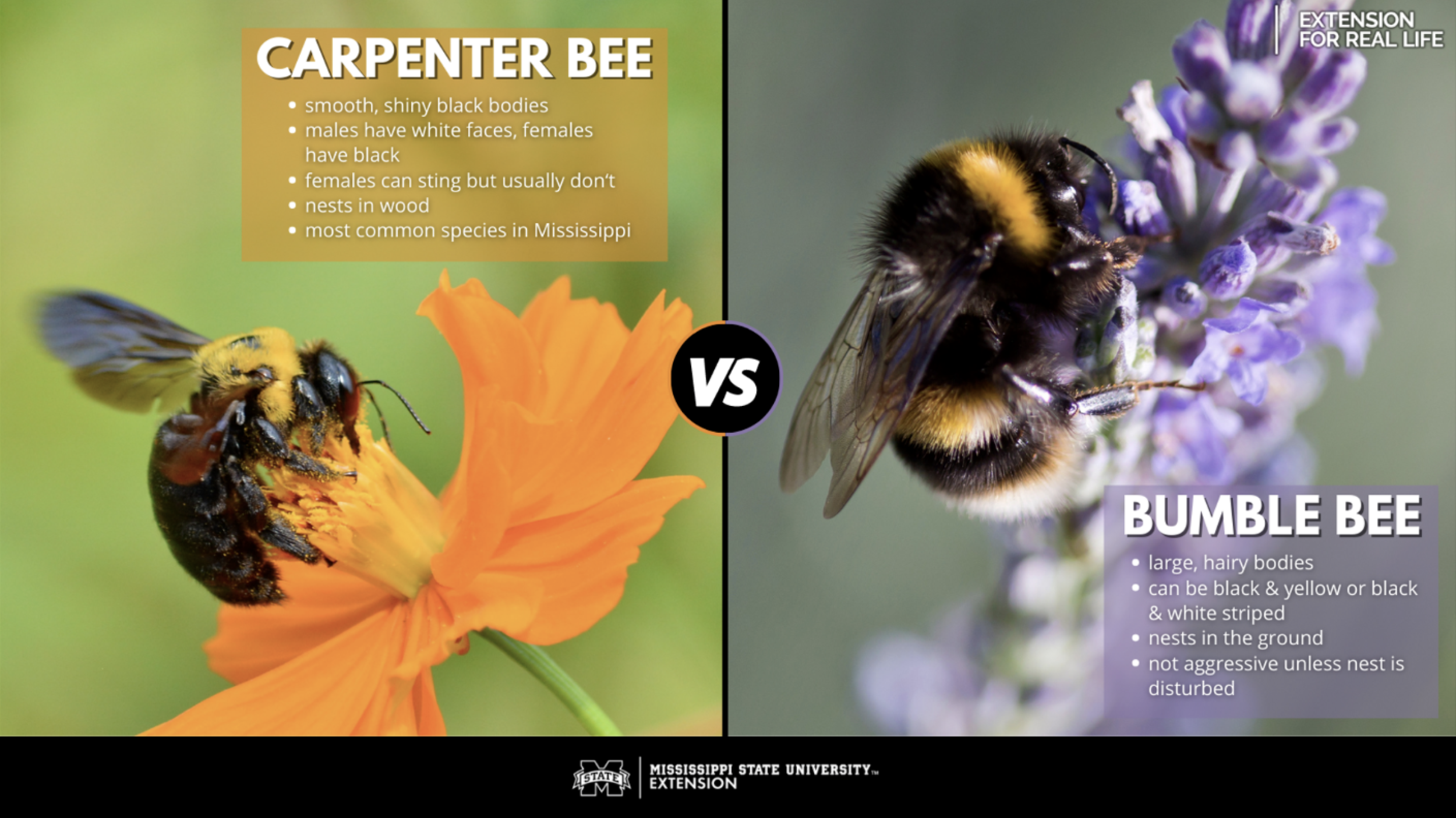
How can we tell a carpenter bee from a bumblebee or honeybee?
Konrad gave us perhaps the easiest identification trick we'll ever remember:
Look for the “shiny hiney.”
Yes, that's the official unofficial test.
Carpenter bees typically have a smooth, dark and shiny abdomen, while bumblebees tend to be much fuzzier.
Honeybees are generally smaller and have the more familiar striped appearance most of us recognize.
So, if you see a big bee and notice that smooth, shiny black backside?
You may have found a carpenter bee.
Now for the question everyone wants answered: Will they sting?
The short answer? They can, but probably won't.
Female carpenter bees are capable of stinging, but Konrad says they rarely do unless they're directly pressed, handled or physically agitated.
The males can't sting at all.
They can, however, put on quite the performance.
“When males get defensive, they simply buzz loudly,” Konrad explained.
They may hover around you, fly toward you and make enough noise to convince you that something terrible is about to happen.
But it's mostly a bluff.
Think of them as the guy making the biggest commotion in the room while having absolutely nothing in his pocket.
What about the wood?
Of course, there's a practical side to living alongside carpenter bees.
Their name comes from their habit of creating nesting tunnels in wood, and repeated nesting in the same wooden structure can cause damage over time.
According to Konrad, a single nesting tunnel doesn't mean your porch is in danger. The concern comes when large numbers of carpenter bees repeatedly use the same wooden structure, creating more and more tunnels over time.
That can become particularly concerning with older barns and other exposed wooden structures.
So yes, carpenter bee damage shouldn't simply be ignored.
But protecting your home and protecting pollinators don't have to be opposing goals.
There are ways to protect your property while making room for these important pollinators.
What role do carpenter bees actually play in pollination?
This is where Konrad's explanation gets especially interesting.
“Just like other bees, they pollinate a wide variety of bushes, trees and flowers,” he said.
But carpenter bees have another trick.
Their powerful buzzing can help shake loose larger amounts of pollen from certain flowers, a process commonly known as buzz pollination.
Essentially, the bee's vibration helps release pollen that isn't as easily accessible to some other pollinators.
So that loud buzzing we sometimes find annoying?
Nature has a use for it.
Their size, strength and unique pollination behavior allow carpenter bees to contribute to the pollination of plants in ways that complement the work of other bees.
And with pollinators playing such an important role in our ecosystems and food supply, that's not something we should casually dismiss.
Okay, Konrad. I appreciate the bees, but I also appreciate my porch.
Fair enough.
Fortunately, protecting pollinators doesn't mean handing over the deed to your house.
Konrad says there are alternatives to simply killing carpenter bees.
“Carpenter bee homes are very easy to make and hang in the yard,” he explained.
Another option is providing a slab of unfinished, fresh-cut pine near an existing nesting area. Giving the bees an attractive alternative can help redirect nesting activity away from barns, homes and other structures you'd rather protect.
The idea is refreshingly simple:
Redirect instead of destroy.
If you're dealing with extensive existing damage, especially on an older structure, it's still smart to have the wood evaluated and take appropriate steps to protect it.
Saving the bees doesn't require sacrificing the barn.
What's the biggest misconception about carpenter bees?
“Many people think they are wasps or bumblebees,” Konrad said, “but they are their own type of bee and have a very specific role in nature.”
And maybe that's the larger lesson here.
We tend to group bees together, especially when we're afraid of them.
But honeybees, bumblebees and carpenter bees aren't interchangeable. Their nesting habits, appearances, behaviors and roles within the ecosystem can be very different.
Understanding what we're actually looking at can change the conversation.
A carpenter bee isn't simply “that giant bee drilling holes in my fence.”
It's a pollinator.
It's a homebuilder.
And yes, occasionally, it's an inconsiderate neighbor who has chosen the exact piece of wood you wish it hadn't.
One last question, Konrad: Why should people think twice before automatically killing them?
His answer may be the most important one of the entire conversation:
“We all need as many pollinators as possible.”
Honeybees tend to get most of the attention, but they're only one part of a much larger pollination system. Carpenter bees, bumblebees and countless other pollinators each contribute in their own way.
And sometimes protecting nature starts with something incredibly simple:
Learning what we're looking at before deciding we're afraid of it.
So the next time a big black bee comes buzzing around your porch like it pays the mortgage, don't panic just yet.
Remember Konrad's advice.
Check for the shiny hiney.
Give it some space.
And before you decide what to do, consider whether there's a way for you and your very loud little neighbor to coexist.
After all, it may be drilling a hole today.
But tomorrow, it could be helping your garden bloom.
This article is based on a Healthy Hive Foundation interview with Konrad Bouffard, expert beekeeper, Talking Bees Roadshow partner, and founder of Round Rock Honey.
Thumbnail photo by Enairam92, Wikipedia Commons